
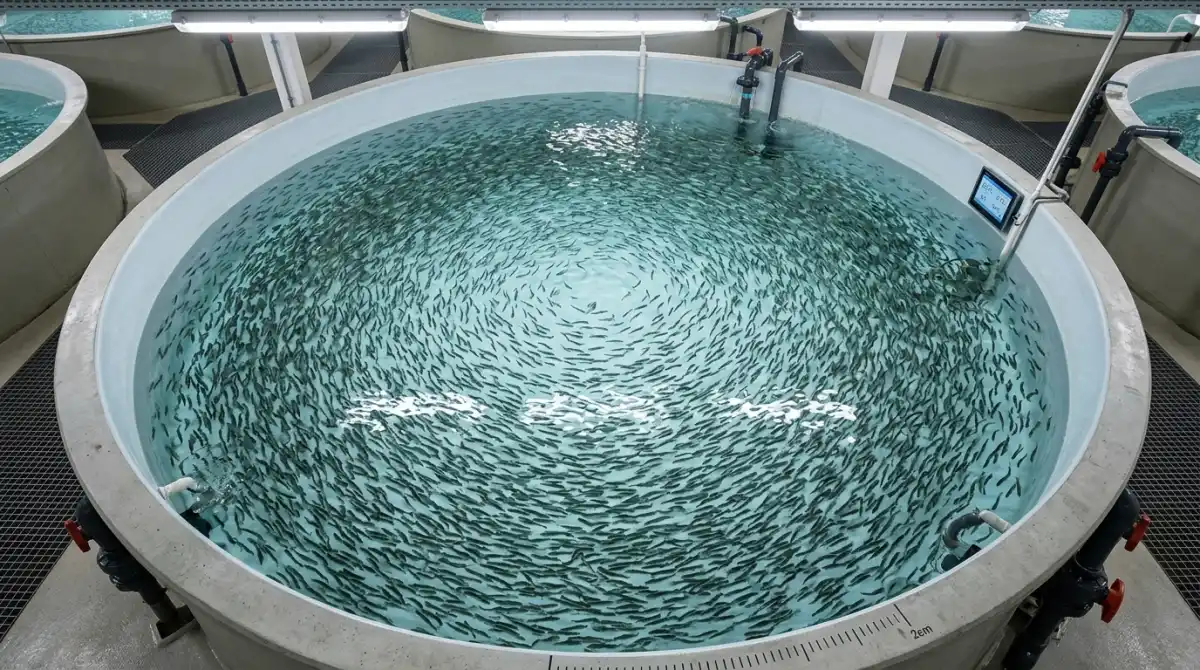
A hatchery ships 500,000 fry per week. Every miscount means either lost revenue or an angry customer. The AI counts them without touching a single fish.
Fish fry counting is one of aquaculture's most tedious bottlenecks. Hatcheries need accurate counts for sales, stocking density control, and regulatory compliance, but the traditional methods are slow, imprecise, and stressful for the animals. Manual counting carries 10 to 20% error margins. AI-powered optical counting systems now achieve 99% accuracy or better, processing up to 200,000 fish per hour without any physical contact.
The problem with manual counting
Traditional fry counting relies on three methods, and none of them are good.
Workers net small batches of fry, count them by hand, and extrapolate to the full tank. Slow, inconsistent, and stressful for the fish. Each handling event increases mortality risk from physical injury and osmotic shock.
Weigh a sample of 100 fry, then weigh the entire batch and divide. Fast, but accuracy varies wildly with size variation within the batch. A 15% size range in the sample can produce a 10 to 20% counting error.
Estimate count based on water displacement. Rough at best. Only useful for very large batches where approximate numbers are acceptable.
Handling stress is the hidden cost. When fry are scooped, netted, or poured between containers for counting, they experience physical injury, confinement stress, and ion-osmotic imbalance. Younger larvae are especially vulnerable: research shows that fry under 35 days old have significantly weaker resistance to handling stress than fully metamorphosed juveniles. Every unnecessary handling event adds to cumulative mortality.
How AI fish counting works
AI fish fry counting uses camera-based detection to identify and count individual fish as they pass through a controlled channel or swim in a tray. The process is entirely non-contact: no netting, no scooping, no handling.
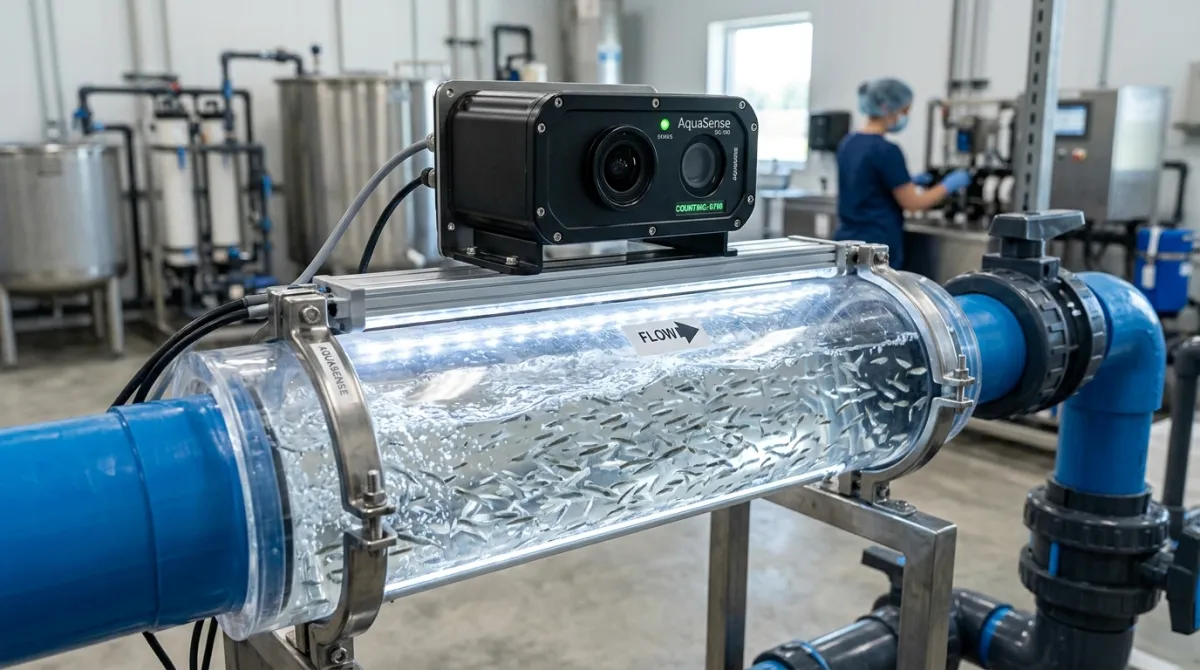
In flow-through systems, fry travel along a water slide or transparent pipe past a camera. The AI detects individual fish heads and tails, counts each one as it crosses a detection line, and tracks movement across video frames to prevent double-counting. Systems like the i-ocean AI Fish Counter operate during regular tank transfers or shipment loading, so counting happens as part of the existing workflow rather than as a separate step.
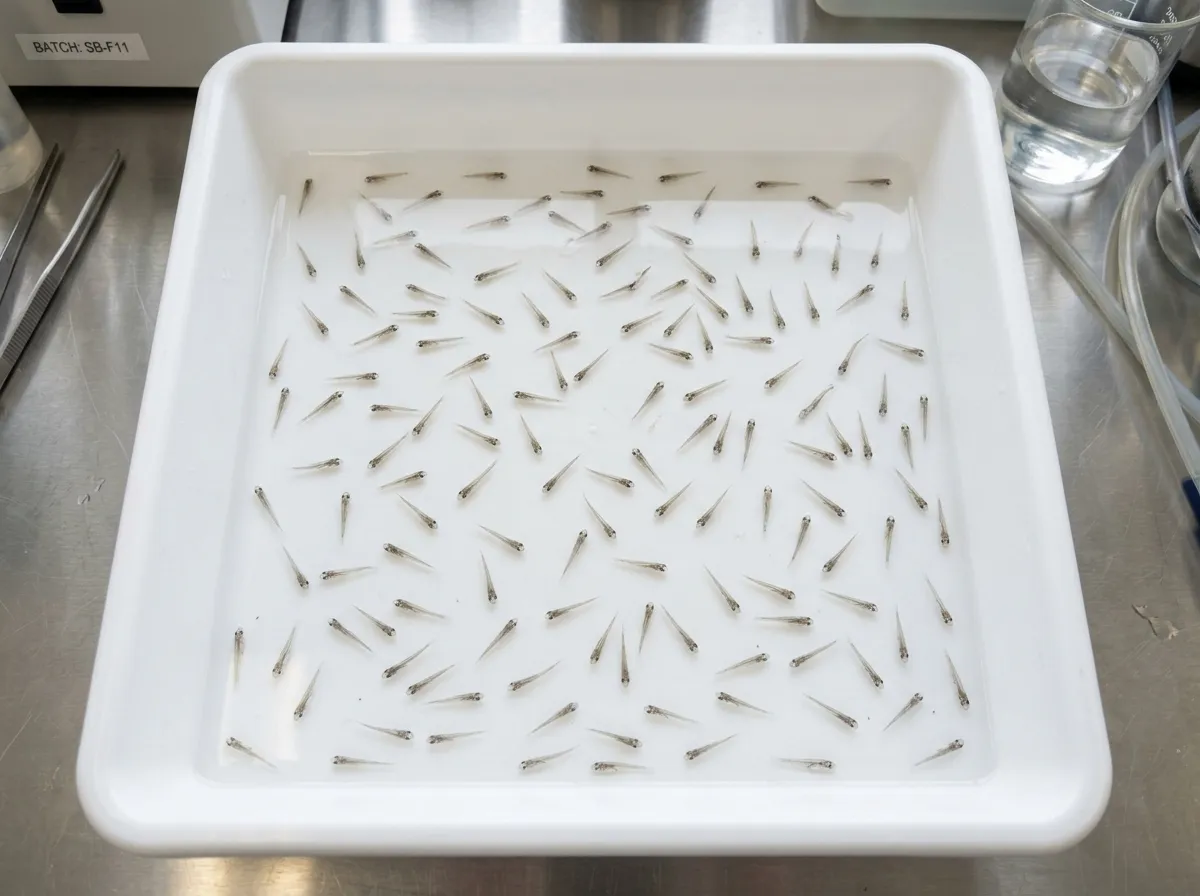
For smaller operations or spot-checks, photo-based counting offers a simpler approach. Spread fry in a shallow tray or viewing window, photograph from above, and the AI detects and counts individual fish in the image. This works well for batches of a few hundred to a few thousand fry and requires nothing more than a smartphone and good lighting.
Accuracy and speed benchmarks
Commercial AI fry counters report 99% accuracy or higher under normal operating conditions. Research systems push even further: the DOT-Net model (2025) achieved a mean absolute error of just 2.48 on dense carp fry datasets, and YOLOv8-ByteTrack devices designed for production hatcheries are entering commercial deployment.
Speed depends on the system type. Flow-through optical counters process 50,000 to 200,000 fish per hour. Photo-based counting returns results in seconds per image, making it practical for smaller batches or quality-control spot-checks.
The accuracy advantage compounds with scale. A 10% error on a shipment of 100,000 fry means 10,000 fish miscounted - enough to trigger disputes with buyers or stock a pond at the wrong density. At 99% accuracy, the error drops to around 1,000 fish, and the count is documented with a photo record.
Species and life stages
AI counting adapts to different species and sizes. Current systems support tilapia fry, salmon smolt, yellowtail, sea bass, trout, carp, and ornamental fish. The i-ocean system offers customizable hose diameters from 10 to 25 centimeters to accommodate different fish sizes.
Shrimp and prawn larvae present a tougher challenge due to their translucency and tendency to cluster, but specialized models are making progress. For most standard hatchery species at the fry or fingerling stage, AI counting is already production-ready.
The business case
The fish fry counter market is projected to reach 56 to 76 million dollars by 2032, driven by aquaculture's 5 to 6% annual growth rate. The return on investment for individual hatcheries comes from four areas.
- Reduced labor: counting 500,000 fry manually takes a team several days. An optical counter does it in hours with one operator
- Lower mortality: non-contact counting eliminates handling stress, reducing fry losses during the counting process itself
- Accurate stocking: precise counts ensure correct stocking densities, which directly affects growth rates and feed efficiency
- Buyer confidence: documented counts with photo or video records reduce disputes and build trust with wholesale buyers
Getting started
For large hatcheries shipping tens of thousands of fry daily, a dedicated flow-through counter pays for itself quickly. For smaller operations, nurseries, or ornamental fish breeders, photo-based counting is the practical entry point: spread a batch in a tray, photograph it, and get an accurate count in seconds.
The next time a customer asks exactly how many fry are in the bag, the answer will be on your screen before the bag is sealed.