
A stack of logs looks countable until you stand in front of it with rain on your clipboard and mud on your boots.
Counting logs with AI is one of the cleanest photo-based counting use cases: every visible log end is a circle or oval, repeated across a stack. The problem is not that humans cannot count logs. The problem is that log yards, sawmills, and forestry crews need counts often, in rough conditions, and without stopping the flow of trucks. Research on mobile timber-stack measurement has shown that phone-based machine vision can detect log ends and estimate stack volume directly from images. A 2019 study on TRESTIMA Stack found that a mobile system could measure stacked timber with a mean relative error of 4.7% for pile solid volume.
Why log counting is harder than it looks
The simple version is one pile, one species, all cut to the same length, photographed from the end. The real version is messier. Logs are stacked at slight angles. Bark flakes off. Ends are wet, cracked, shadowed, or covered by sawdust. A few logs sit deep inside the pile with only half an end visible. Trucks arrive while someone is still reconciling the previous load.
Manual tallying also produces a weak record. A number written on a form tells you the total, but not what was actually counted. If a buyer, hauler, or mill operator questions the count later, the best evidence is usually a photo. AI counting starts with that evidence: the image is not a side note, it is the source of truth.
How AI counts logs from a photo
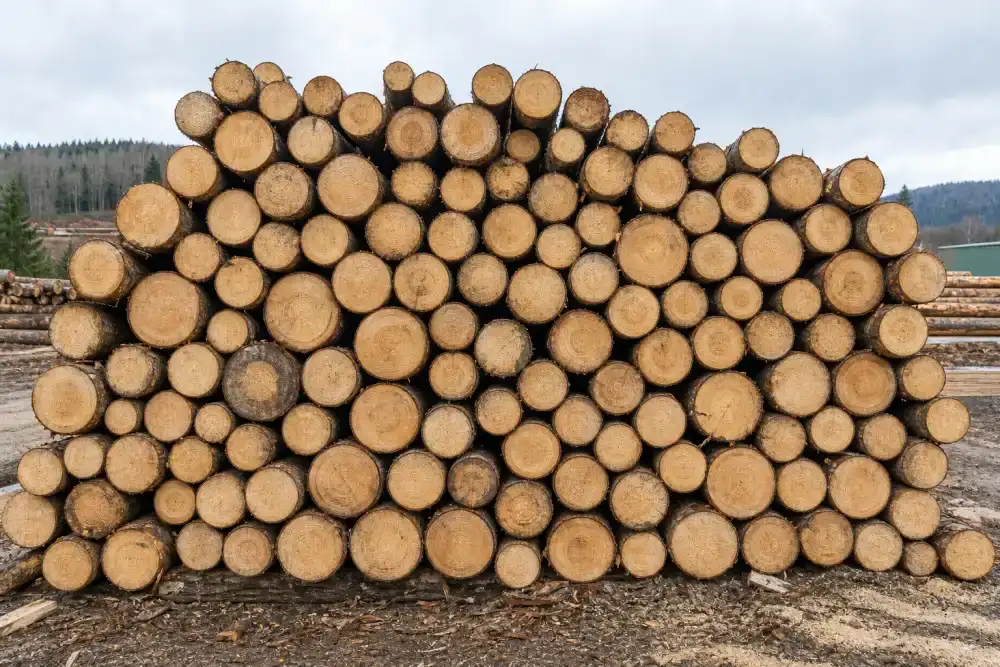
The workflow is direct. Stand in front of the stack, keep the camera square to the log ends, capture the full face of the pile, and upload the photo. The AI scans for circular and oval log ends, places a marker on each detected log, and returns a count. The operator reviews the overlay, adds any missed partial logs, removes false detections, and saves the result.
Modern object-detection models are especially useful for this kind of repeated shape. A 2023 study on stacked eucalypt timber used an improved YOLOv8 model for log-end detection and reported 97.3% average precision. Another 2024 forestry paper combined log counting with volume estimation from 2D images and reported strong agreement between AI estimates and reference measurements. For day-to-day inventory, that means the count becomes fast enough to repeat, not just something you do at audit time.
Where AI log counting fits
Photograph each truck load as it arrives, count visible log ends, and attach the image to the receiving record.
Check how many stems are waiting by species, length, or grade without walking every row with a tally counter.
Capture stacks before haulage so contractors and buyers share the same visual record.
Use the marked image to resolve count differences instead of arguing over a handwritten total.

Take the photo like a survey, not a snapshot
- Face the log ends directlyA square-on image keeps circles from turning into stretched ovals.
- Capture the whole pile faceCropping off the top or side of the stack creates instant undercounting.
- Avoid harsh side lightWet bark and fresh cuts reflect light. Diffuse daylight gives cleaner edges.
- Stand far enough backLet the camera see the full stack without wide-angle distortion at the edges.
- Count one stack at a timeDo not include the next pile, the truck bed, and loose ground logs in the same image.
- Use the overlayThe marked photo is the quality check. If a hidden or partial log matters, correct it before saving.
Counting is not the same as scaling
Log counting and log scaling are related, but they are not the same job. Counting asks, "How many logs are visible?" Scaling estimates volume, often using diameter, length, taper, species, and local rules. AI counting is useful even when formal scaling still happens later because it gives a fast, documented quantity check at the point of movement.
For example, a roadside crew may not need a final board-foot estimate before pickup. They need to know whether the pile has 86 logs or 103, whether a partial load was removed, and whether the photo record matches the dispatch ticket. A quick AI count answers that operational question in seconds.
Limits worth respecting
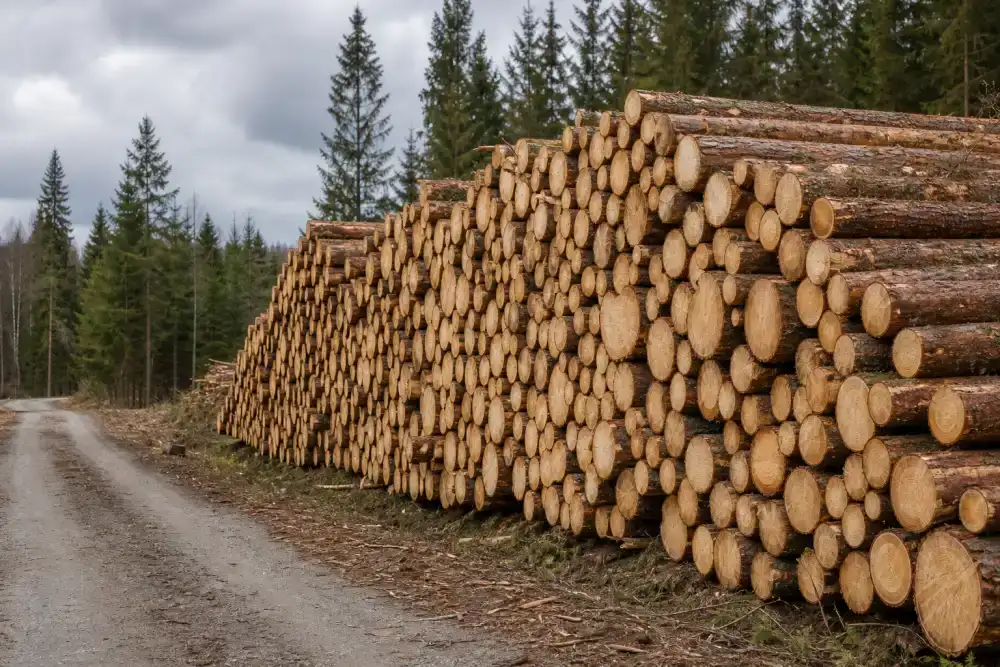
AI is strongest when the log ends are visible, separated enough to see their boundaries, and photographed from the front. It struggles when piles are shot from the side, when logs are buried deep behind other logs, or when snow, mud, tarps, or shadows hide the ends. That is not a failure of the counting method. It is a reminder that AI can only count what the camera can see.
- Use manual review for stacks with heavy overlap or broken, irregular ends.
- Do not rely on one photo for a long curved pile. Split it into sections.
- Keep counting and volume estimation separate unless your workflow is designed for both.
- Save the marked image with the job record so the count can be checked later.
The bottom line
Log counting is repetitive, weather-exposed work where a photo already helps. AI adds the missing layer: a visible marker on each log, a total you can review, and a record that travels with the load. It will not replace formal timber scaling, but it can make everyday log-yard inventory faster and easier to audit.
Next time a truck drops a stack, take one square-on photo before anyone moves the logs. Count it by eye, then let AI count the same image. The useful part is not just the number. It is seeing exactly which logs were counted.