
A full warehouse count shuts operations for a day. An AI spot-check takes a coffee break.
Manual inventory counts are one of the most expensive routines in warehouse operations. A medium-sized facility with 5,000 SKUs needs 1 to 3 days of full shutdown to count everything, plus overtime pay and temporary hires to get it done. Meanwhile, nothing ships, nothing receives, and every hour of downtime has a dollar figure attached. AI-powered photo counting offers a faster alternative for daily spot-checks, receiving verification, and cycle counts.
The real cost of manual counting
Most warehouse managers know counting is slow. Fewer realize how expensive it actually is.
A full physical inventory at a 20,000-SKU operation can take an entire weekend. Staff count aisle by aisle, writing tallies on clipboards or scanning barcodes one at a time. Temporary workers make more errors than regular staff, but regular staff are pulled from their actual jobs. CPCON Group estimates that companies spend significant labor hours and hiring costs on each full count.
Then there is shrinkage. U.S. retailers lose an estimated $112 billion annually to shrinkage, with 21% of that attributable to administrative errors - miscounts, data entry mistakes, and incorrect receiving tallies. Most shrinkage accumulates between infrequent counts. The longer the gap between counts, the more invisible losses grow.
1 to 3 days of shutdown. All warehouse staff plus temporary hires. Nothing ships or receives during the count.
1 to 4 dedicated counters, 30 to 60 minutes per session. Covers 50 to 80 SKUs per day. Less disruption, but slower to cover the full inventory.
One person with a smartphone. Photograph a shelf, pallet stack, or receiving bay. Count returned in seconds. No shutdown required.
How photo-based counting works in a warehouse
The workflow is four steps: snap, count, verify, log.
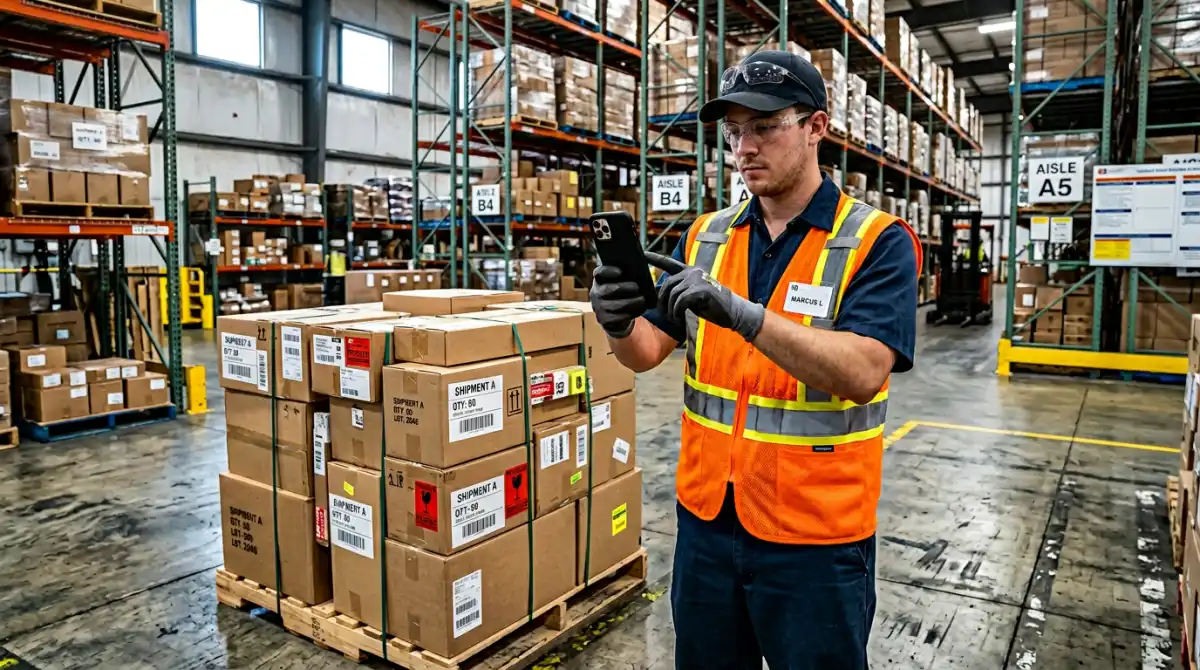
A warehouse worker points a phone at a pallet stack or shelf section and takes a photo. The image goes to an AI counting model that detects and marks each visible item with a colored dot. A total count appears in seconds. The worker reviews the overlay, taps to add any items the AI missed (usually items hidden behind others), and logs the verified count.
Modern AI vision systems like Vimaan and Loadzy process up to 3,000 pallets per hour using mounted cameras on forklifts, compared to roughly 100 pallets per hour with manual barcode scanning. Even with a handheld smartphone approach, a single worker can count a shelf section in under 10 seconds that would take several minutes by hand.
Accuracy benchmarks
Accuracy depends on the photo quality and how well-separated the items are. Under controlled conditions with good lighting and clearly visible objects, AI counting systems achieve 97 to 99% accuracy. A fine-tuned YOLOv11 model tested in real warehouse conditions hit 97% accuracy across multiple test rounds (Springer, 2026).
Commercial warehouse vision platforms report even higher numbers: Loadzy claims 99.9% accuracy for pallet identification, and Vimaan reports 100% location accuracy for their mounted camera systems. These figures represent best-case installations with optimal camera placement and lighting.
For ad-hoc smartphone photos, expect 95 to 98% accuracy on well-photographed scenes - better than the 91% average for manual counting, and delivered in a fraction of the time.
Best practices for warehouse photos
- Shoot from an overhead or straight-on angle to minimize occlusion
- Photograph one item type per image (do not mix pallets and loose boxes)
- Ensure adequate lighting - warehouse overhead lights are usually sufficient
- Keep the camera steady and tap to focus before shooting
- For tall pallet stacks, photograph each tier separately
AI spot-checks vs. full manual audits
AI photo counting does not replace full physical inventories entirely - it changes how often you need them. Instead of counting everything once or twice a year, warehouse teams can run daily AI spot-checks on high-value or fast-moving SKUs and reserve full counts for annual audits or regulatory requirements.
This hybrid approach catches discrepancies early, before they compound into significant shrinkage. A daily 15-minute photo walk through priority aisles can flag a miscount that would otherwise go unnoticed for months. The AI provides speed and consistency; the full audit provides completeness and compliance.
The bottom line
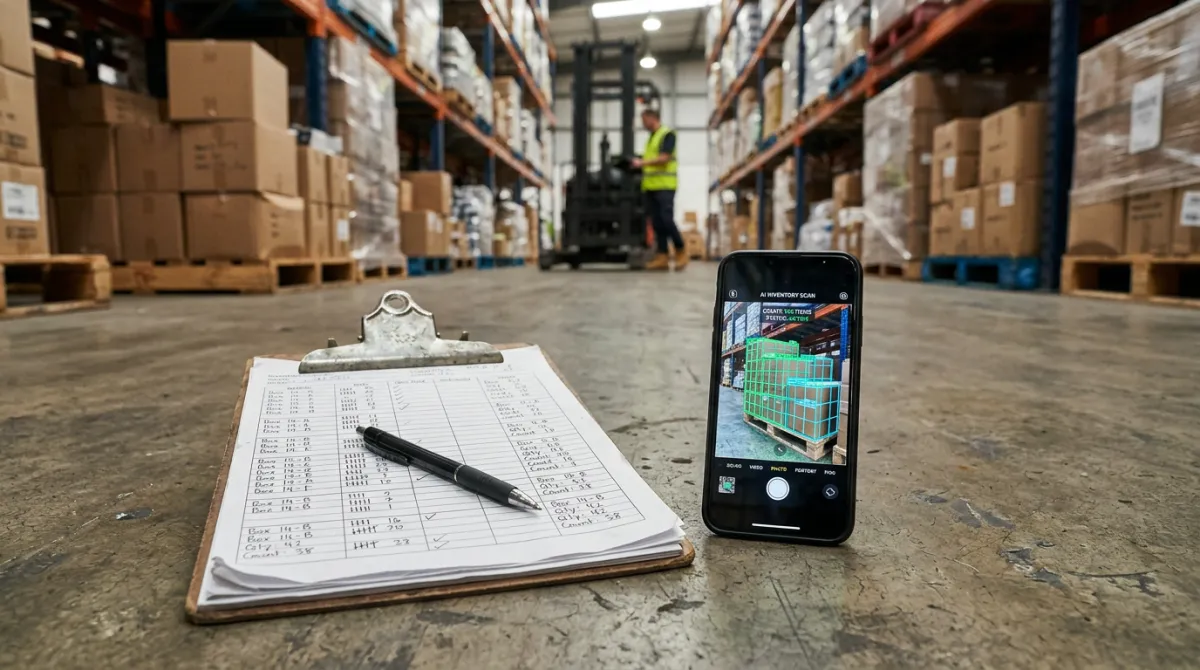
Warehouse counting has been slow and expensive for decades because there was no alternative. Photo-based AI counting changes the math: 30 to 40 times faster than handheld scanning, 95 to 99% accurate, and accessible to anyone with a smartphone.
The next time a shipment arrives and your team starts counting boxes one by one, try photographing the pallet instead. The count will be on your screen before they finish the first row.