
AI is not always the answer. But for anything over 20 items in a photo, it almost always is.
Every counting method has trade-offs. Manual counting is flexible, requires no technology, and works everywhere. AI counting is fast, consistent, and scales effortlessly. The trick is knowing which situations favor which approach. This guide lays out the honest comparison so you can make the right call for your specific task.
The speed comparison
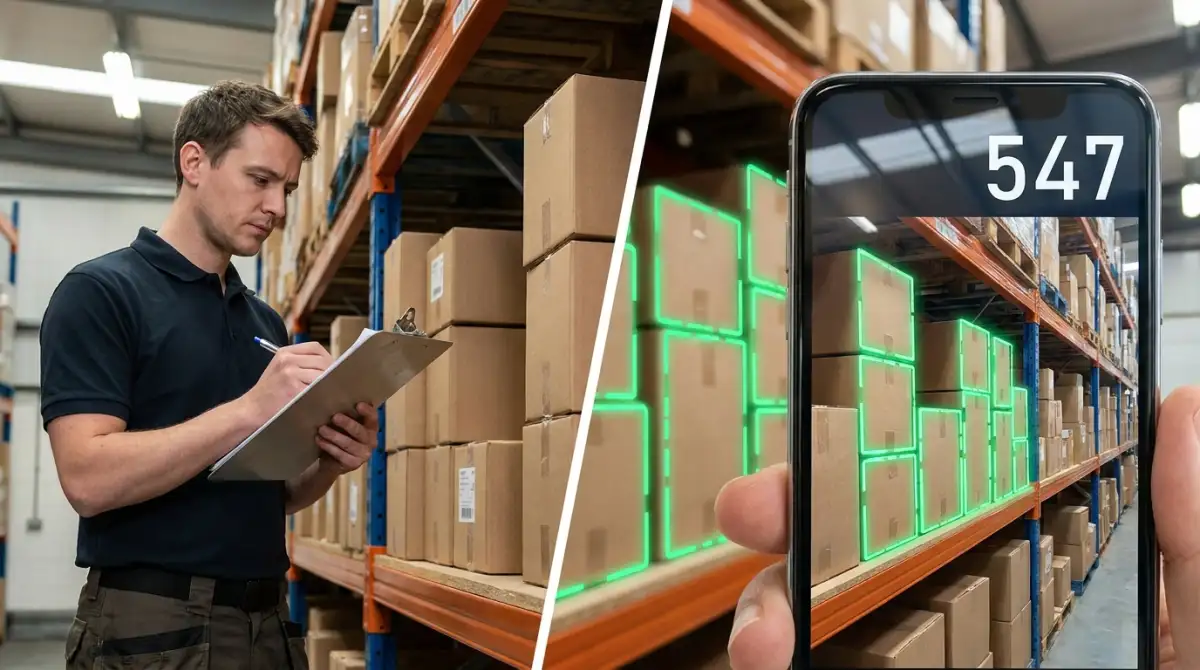
Manual counting speed depends on the counter, the complexity of the scene, and how much is at stake. A careful warehouse worker processes roughly 200 to 300 items per hour. A pharmacist hand-counting pills on a tray manages about 150 to 250 per hour. In both cases, the bottleneck is the same: human eyes scanning, one item at a time.
AI counting operates in a fundamentally different gear. A modern vision model processes an image in under 3 seconds, even on a smartphone. That single image can contain hundreds of items, all counted in one pass. A shelf of 400 bolts that takes a worker 90 minutes to count manually takes the AI about 2 seconds from the moment the photo is uploaded.
The gap widens with volume. A team of four people doing a full warehouse inventory over 2 to 3 days can be replaced by one person with a phone camera completing the same count in hours. The bottleneck shifts from counting to photographing.
The accuracy comparison
Accuracy is where the debate gets interesting, because both methods have specific conditions where they excel.
Human counters average about 91% accuracy at normal working speed, according to inventory research by Nventify. That number drops to 80 to 85% after several hours of repetitive counting as fatigue accumulates. Accuracy degrades 15 to 20% over an 8-hour shift. The error is not random: people tend to undercount (skipping items) more than overcount (double-counting).
AI counting models achieve 95 to 99% accuracy under good conditions: clear photos, distinct objects, reasonable lighting. In controlled warehouse tests, fine-tuned models hit 97% accuracy consistently. The AI does not fatigue, does not lose its place, and returns the same result every time it processes the same image.
The catch: AI accuracy depends entirely on image quality. A blurry photo, extreme shadows, or heavily overlapping objects can push accuracy below what a careful human would achieve. The algorithm is only as good as the photo you give it.
The cost comparison
Manual counting costs labor hours. A mid-size warehouse operation processing 10,000 inventory transactions monthly spends significant staff time on physical counts. Research from iFactory found that manual counting errors in similar operations cost approximately $240,000 annually in discrepancies, shrinkage, and recount labor.
AI counting costs a software subscription or per-count fee. The ongoing cost is predictable and does not scale with headcount. Organizations that switch to AI-powered inventory counting report up to a 70% decrease in time spent counting and a 95% reduction in discrepancies.
For small-scale, occasional counting, manual is effectively free. For any operation doing regular counts of more than a few hundred items, the math favors automation quickly.
Where AI wins decisively
Anything above 50 items in a single scene. The accuracy gap between human and AI widens with every additional item.
Daily inventory checks, production line tallies, and shift-end verifications. Consistency matters more than any single count.
Incoming shipment verification, event crowd estimation, and time-sensitive inventory audits where minutes matter.
Every AI count produces a photo with markers: visual proof of what was counted, when, and where. Manual tallies leave only a number.
Counting rebar on a construction site, livestock across rough terrain, or items in high-rack warehouse shelving. A photo is safer than climbing.
Where manual counting still wins
Being honest about limitations builds more trust than overpromising. Here are the situations where counting by hand is still the better choice.
- Fewer than 10 items - Your brain subitizes small groups instantly. Opening an app takes longer than glancing at a handful of parts.
- Fully concealed objects - Items inside sealed boxes, underneath other items, or behind opaque barriers are invisible to any camera.
- Mixed irregular shapes - A random assortment of very different objects in a pile confuses models that expect visual consistency within a group.
- No camera available - Sometimes the fastest tool is your index finger and a quick count.
- Judgment calls required - Counting damaged vs. undamaged items, or categorizing by condition, requires human interpretation that pure counting models do not provide.
The hybrid approach
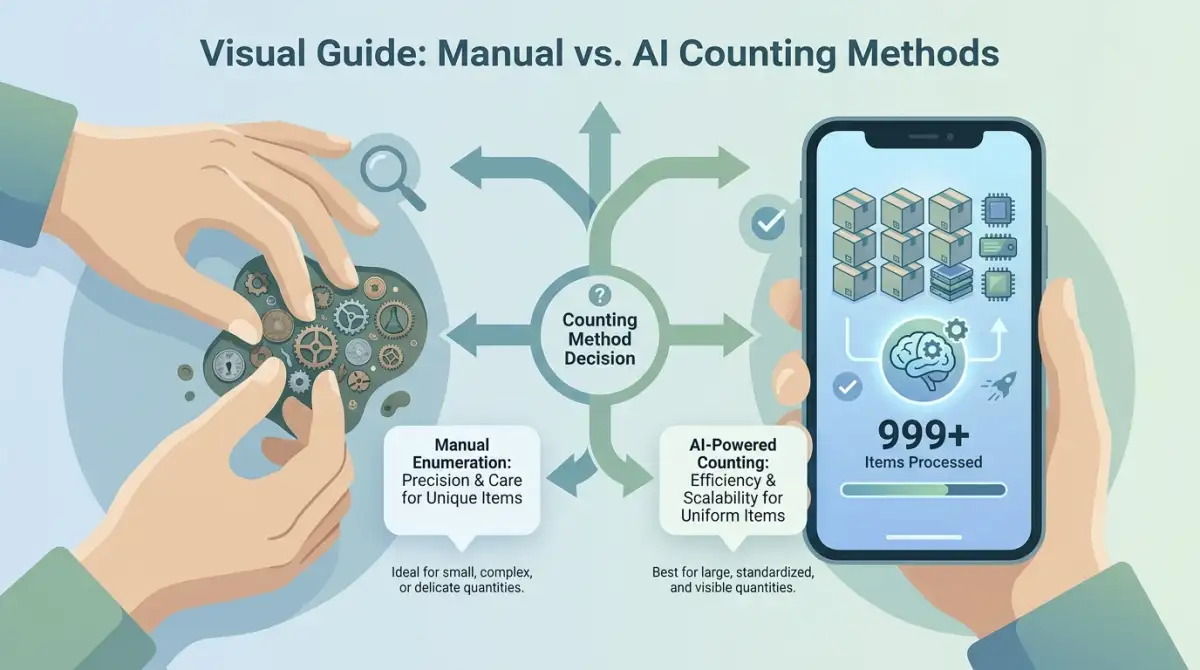
The smartest teams do not pick one method exclusively. They use AI for the bulk count and manual verification for the edge cases.
A practical hybrid workflow looks like this: snap a photo and let AI produce the initial count with detection markers. Review the marked image for any obvious misses or false detections. Tap to add missed items or remove false positives. Confirm and save. The entire process takes a fraction of manual counting time while catching the errors that pure automation might miss.
This hybrid approach consistently delivers the highest accuracy of any method: the speed and consistency of AI combined with the contextual judgment of a human reviewer.
A simple decision guide
- More than 20 visible items?Use AI counting. The accuracy and speed advantage kicks in above this threshold.
- Items clearly visible and not overlapping?AI will deliver 95%+ accuracy. Proceed with confidence.
- Recurring count you do daily or weekly?AI saves cumulative hours and eliminates drift in counting consistency.
- Need a documented record?AI provides timestamped photos with markers. Manual counting leaves only a number.
- Items hidden, sealed, or fewer than 10?Count by hand. It will be faster and just as accurate.
- Unusual shapes or mixed categories?Start with AI for the initial count, then manually verify and adjust.
The bottom line
Manual counting is not obsolete, and AI counting is not infallible. The right answer depends on what you are counting, how many there are, and how much accuracy matters. For the vast majority of practical counting tasks involving more than a handful of visible items, AI delivers a faster, more accurate, and better-documented result.
Try both on your next count. Tally a shelf by hand, then snap a photo and let the AI do the same shelf. Compare the results, the time, and the effort. The numbers will speak for themselves.