
A pharmacist fills 200 prescriptions a day. Each one starts the same way: pour pills onto a tray, spread them out, count by fives, lose track, recount. Multiply that by every prescription, every shift, and the hours add up fast.
Manual pill counting is one of pharmacy's most repetitive tasks. It is slow, error-prone, and surprisingly expensive when measured across a full workday. AI-powered pill counting changes the math: pour the pills, snap a photo, and get an accurate count in seconds. Here is how pharmacies are adopting it and why the results are hard to ignore.
What manual counting actually costs
Filling a single prescription takes 2 to 3 minutes of hands-on work, not including verification and labeling. A significant chunk of that time goes to counting. For a pharmacy filling 200 prescriptions per day, counting alone consumes hours of technician time.
The errors are the hidden cost. A miscount means recounting, relabeling, or in the worst case, dispensing the wrong quantity. The FDA receives over 100,000 medication error reports annually, and quantity discrepancies are among the most common. Even experienced technicians make mistakes when fatigue sets in during a 12-hour shift.
Then there is the compliance burden. Every controlled substance requires documentation. Manual counts need double-verification, paper logs, and periodic audits. A single counting error on a Schedule II medication triggers a regulatory paper trail that takes far longer to resolve than the original count.

How AI pill counting works
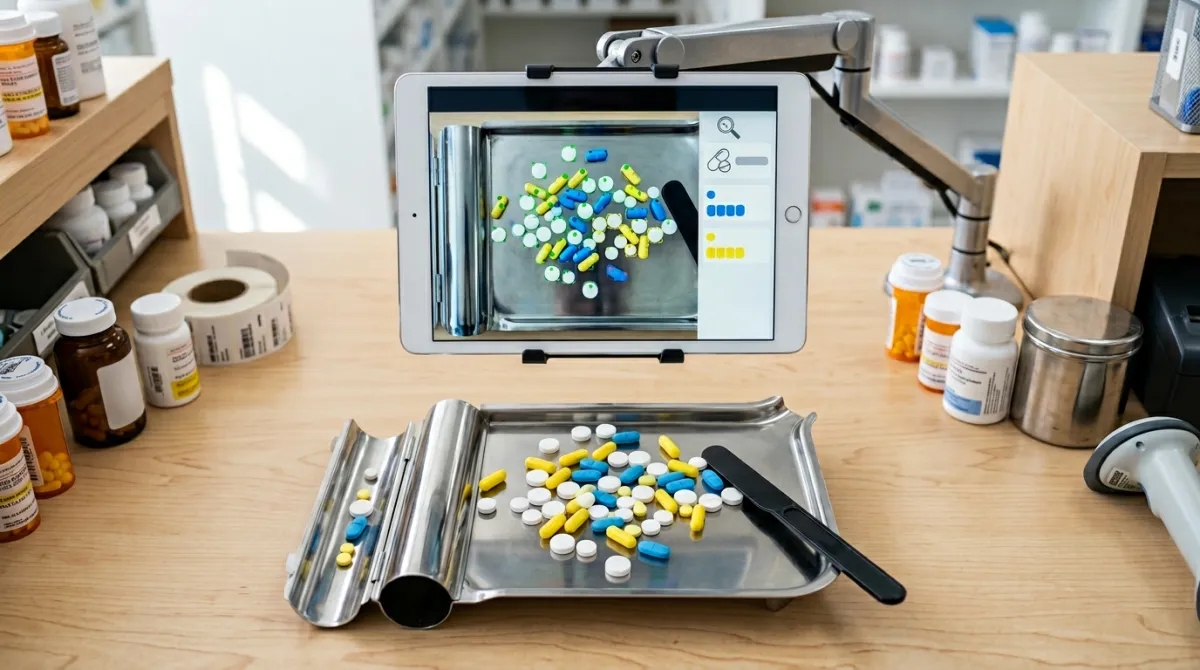
The workflow is disarmingly simple. A pharmacy technician pours pills onto a standard counting tray, the same tray they already use. Instead of counting by fives with a spatula, they position the tray under a camera or snap a photo with a tablet.
The AI processes the image in under 3 seconds. It identifies individual pills, marks each one with a detection point, and returns a total count. The technician reviews the overlay, confirms the count, and moves on. For a prescription of 60 tablets, the process that used to take 45 seconds of careful counting now takes a glance.
Modern AI pill counters like PillEye offer two modes. Photo Mode handles quick snapshot counts for standard prescriptions. Live Mode processes a video feed continuously, updating the count as pills are added or removed from the tray. This handles even large quantities, up to 1,000 pills, without batching.
Accuracy that meets pharmacy standards
Pharmacy demands near-perfect accuracy. A miscount is not just inconvenient - it can affect patient safety.
PillEye reports up to 99.999% counting accuracy, validated across standard tablets, capsules, and half-pills. This exceeds what most human counters achieve under normal working conditions, where fatigue and distraction cause error rates of 1 to 3%.
The system handles tricky edge cases that slow human counters down. Gel capsules that stick together, half-tablets from split doses, and small round pills that blend into the tray surface are all recognized and counted individually. Transparent capsules, which are notoriously difficult to spot against light-colored trays, are detected through contrast-adjusted image processing.
One important caveat: AI counting works best when pills are spread in a single layer. A pile of stacked pills will produce an undercount for the same reason it fools human eyes - the camera only sees the top layer.
The compliance advantage
Beyond speed and accuracy, AI pill counting creates an automatic audit trail that manual counting cannot match.
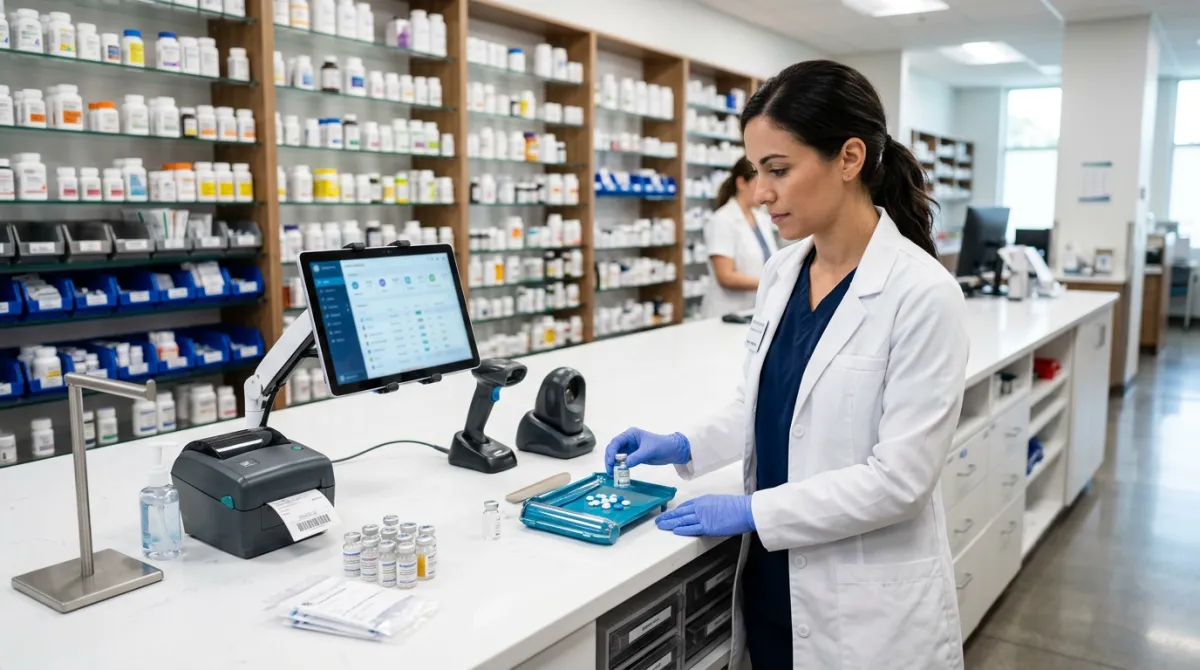
Every count generates a timestamped record: the photo, the count result, the technician ID, and the medication identified via barcode scan. This documentation is stored in the cloud and available for regulatory review at any time. For controlled substances, this replaces handwritten logs with verifiable digital records.
HIPAA-compliant storage means patient privacy is maintained throughout the process. The audit trail tracks counts without exposing patient information, satisfying both state board and federal requirements.
For pharmacies facing DEA audits on controlled substance inventory, having an automatic photo record of every count eliminates the guesswork of manual logs. The timestamp, the image, and the result are all linked and searchable.
Where AI pill counting fits today
High prescription volume, rapid return on investment. One technician handles more prescriptions per hour without sacrificing accuracy.
Precise counts are critical for custom formulations. AI removes the uncertainty from large ingredient batches.
Smaller operations where a single staff member handles dispensing alongside other duties. Quick counts save minutes per patient.
High-volume, fast-paced environments where counting speed directly affects patient wait times and discharge scheduling.
The bottom line
AI pill counting is already deployed in pharmacies worldwide, handling everything from 30-count prescriptions to 1,000-pill batches. The technology costs less than traditional mechanical counting machines, fits into existing tray-based workflows, and produces accuracy rates that meet or exceed pharmacy standards.
The next time a technician faces a tray of 200 tablets, there is no need to count by fives. A photo gets the answer in 3 seconds, and it will be right.