
The product is in the warehouse. It is in the system. It is not on the shelf. And 30% of your customers just walked out the door.
Out-of-stock items cost the global retail industry an estimated 634 billion dollars in lost sales annually, and total inventory distortion adds up to 1.1 trillion dollars. The average out-of-stock rate at point of purchase sits around 8%, and 91% of shoppers who encounter an empty shelf will not wait for a restock - they go to a competitor. AI-powered photo audits detect stockouts in seconds instead of hours, catching problems that manual shelf walks and ERP systems consistently miss.
Why manual shelf audits fall short
Most retailers still check shelves with a low-tech process: a regional manager or store associate walks each aisle, visually scans the shelves, and notes what looks empty. The typical store gets 1 to 3 shelf walks per day, with 3-hour gaps between checks. During those gaps, stockouts accumulate undetected.
Manual audits catch 60 to 70% of stockout events under ideal conditions. The rest go unnoticed: items pushed to the back of the shelf, single units left that look full from a distance, or products displaced to the wrong aisle. Human checkers are fast at spotting completely empty facings but poor at detecting partial stockouts and planogram violations.
Then there is phantom inventory - the silent problem. Phantom inventory is stock that the system says is available but that is not actually on the shelf. It might be in the backroom, misplaced in another aisle, or simply miscounted. Research indicates phantom inventory can cause as much as 80% of out-of-stock incidents, and average inventory records are only about 60% accurate. No amount of manual shelf walks will fix a problem that lives in the data.

How photo-based shelf audits work
The workflow is simple: a store associate points a phone at a shelf section and takes a photo. The AI processes the image, identifies individual products, flags empty facings, and checks compliance against the planned shelf layout (the planogram). Results appear in seconds.
A planogram compliance system deployed across more than 7,000 stores in Taiwan achieved 99.23% precision and 98.93% recall for shelf detection, with product-level detection reaching 94.61% precision and 93.02% recall. That is a substantial improvement over the 60 to 70% detection rate of manual audits.
Edge AI cameras take this further by running detection on-device in under 100 milliseconds, eliminating the need to upload images to a cloud server. Mounted above shelf sections, these cameras provide continuous monitoring rather than periodic snapshots, flagging stockouts the moment they appear.
What AI catches that humans miss
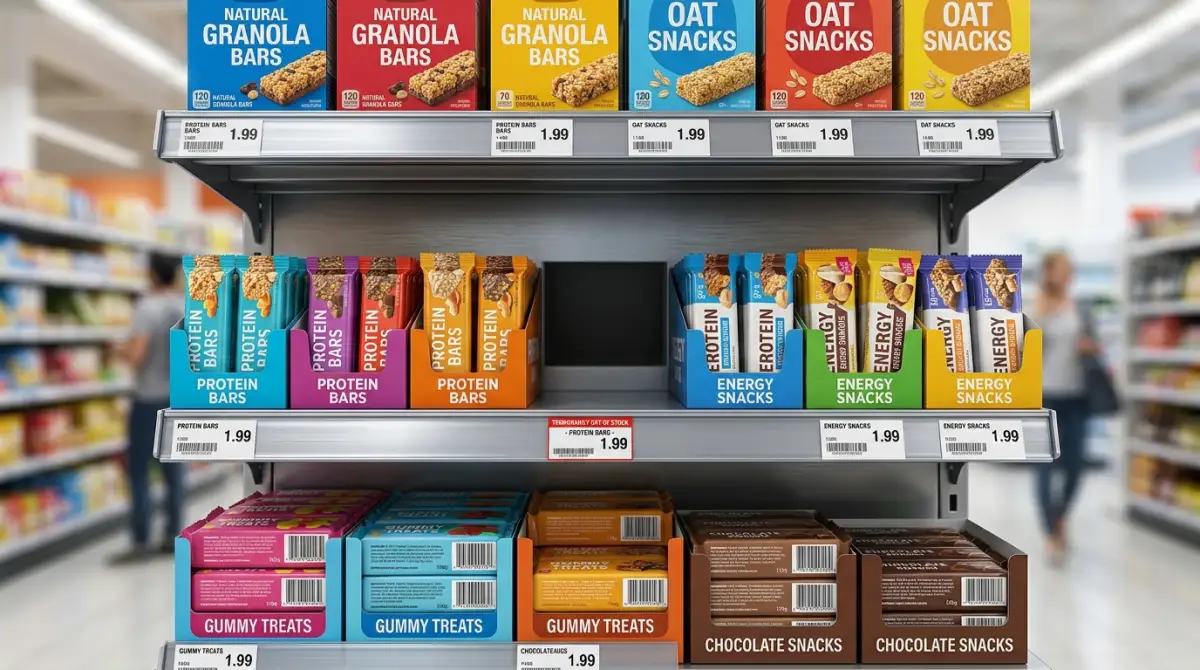
A single unit left on a shelf facing looks fine from 3 meters away. AI counts exact quantities and flags facings below threshold.
Products placed in the wrong slot, blocking the correct item from being restocked. AI matches each facing against the planned layout.
The system shows 24 units in stock, but the shelf has 3. AI provides ground truth from the actual shelf, surfacing data that ERP systems cannot see.
Wrong price labels or missing tags that erode shopper confidence. AI flags inconsistencies during the same shelf scan.
The ROI of faster detection
Speed is where the math changes. Traditional shelf walks take hours to cover a full store, and by the time a stockout is documented, reported, and acted on, customers have already left. AI reduces that detection-to-action cycle from hours to seconds.
The financial impact is direct. Studies show that improving on-shelf availability by even a few percentage points translates to measurable revenue gains. A mid-sized grocery chain with 200 stores recovering just 2% of lost sales from better stockout detection adds millions in annual revenue - without selling a single new product.
The behavioral data is equally stark: 43% of shoppers who encounter a stockout switch to a competing brand, 20% abandon their entire cart, and 9% permanently switch retailers after a single out-of-stock event. Every hour a shelf stays empty compounds the loss.
Getting started with photo shelf audits
- Start with high-value categories: focus AI audits on top-selling or high-margin shelves first
- Use a consistent photo angle: straight-on, well-lit, capturing the full shelf section
- Compare against planograms: upload your planned layout so AI can flag deviations, not just empty facings
- Track trends over time: daily photo audits build a dataset that reveals repeat offenders and systemic gaps
- Integrate with replenishment: connect stockout alerts to backroom workflows so the fix follows the flag

The bottom line
Shelf audits have been a clipboard job for decades because there was no scalable alternative. Photo-based AI changes that equation: 95 to 99% detection accuracy, results in seconds, and the ability to catch phantom inventory that no manual walk or ERP report will ever surface.
The next time a regional manager visits a store and wonders why a best-seller is missing from the shelf, the answer should already be on their phone.